From Wikipedia, the free encyclopedia
End time (also called
end times,
end of time,
end of days,
last days,
final days, or
eschaton) is a time period described in the
eschatologies of the dominant
world religions, both
Abrahamic and non-Abrahamic.
The
Abrahamic faiths maintain a linear
cosmology, with end-time scenarios containing themes of
transformation and
redemption. In
Judaism, the term "end of days" makes reference to the
Messianic Age, and includes an in-gathering of the exiled
diaspora, the coming of the
Messiah, the
resurrection of the righteous and
the world to come. Some sects of
Christianity depict the end time as a period of
tribulation that precedes the
second coming of
Christ, who will face the emergence of the
Antichrist and usher in the
Kingdom of God.
However, other Christians believe that the end time represents the
personal tribulation experienced before they are enlightened with the
Word of God.
[1] In Islam, the
Day of Judgement is preceded by the appearance of the
Mahdi atop a white stallion. With the help of
Isa (Jesus), the Mahdi will blow the triumph over
Masih ad-Dajjal (the false messiah).
Non-Abrahamic faiths tend to have more cyclical world-views, with end-time eschatologies characterized by
decay, redemption and rebirth. In
Hinduism, end time is foretold
[by whom?] as when
Kalki, the final incarnation of
Vishnu, descends atop a white horse and brings an end to the current
Kali Yuga. In
Buddhism, the
Buddha predicted that his teachings would be forgotten after 5,000 years, followed by turmoil. A
bodhisattva named
Maitreya will appear and rediscover the teaching of
dharma. The ultimate destruction of the world will then come through seven suns.
Since the discovery of
deep time and the estimated
age of the Earth, scientific discourse about end time has centered on the
ultimate fate of the universe. Theories have included the
Big Rip,
Big Crunch,
Big Bounce, and
Big Freeze.
Linear cosmology
Zoroastrianism
Main article:
Frashokereti
Zoroastrian eschatology is the oldest in recorded history, with
beliefs paralleling and predating the framework of the major Abrahamic
faiths.
[2][3][4] By the year 500 BC, a fully developed concept of the
end of the world was established in Zoroastrianism. The
Bahman Yasht describes:
At the end of thy tenth hundredth winter, the sun
is more unseen and more spotted; the year, month, and day are shorter;
and the earth is more barren; and the crop will not yield the seed. And
men become more deceitful and more given to vile practices. They will
have no gratitude. Honorable wealth will proceed to those of perverted
faith. And a dark cloud makes the whole sky night, and it will rain more
noxious creatures than water.
A
Manichaean battle between the righteous and wicked will be followed by the
Frashokereti. On earth, the
Saoshyant will arrive as the final savior of mankind, and bring about the
resurrection of the dead. The
yazatas
Airyaman and
Atar
will melt the metal in the hills and mountains, which will flow as lava
across the earth and all mankind, both the living and resurrected, will
be required to wade through it.
Ashavan
will pass through the molten river as if it were warm milk, but the
sinful will burn. It will then flow down to hell, where it will
annihilate
Angra Mainyu and the last vestiges of wickedness.
The righteous will partake of the
parahaoma, which will confer immortality upon them. Humanity will become like the
Amesha Spentas,
living without food, hunger, thirst, weapons or injury. Bodies will
become so light as to cast no shadow. All humanity will speak a single
language, and belong to a single nation with no borders. All will share a
single purpose and goal, joining with
Ahura Mazda for a perpetual and divine exaltation.
[5][6]
Judaism
In Judaism, the main textual source for the belief in the end of days
and accompanying events is the Tanakh or Hebrew Bible. The
Five Books of Moses (the Torah) describe a time when the Jewish people will not be able to keep the
Laws of Moses in the
Land of Israel, and will be exiled but ultimately redeemed. Major sources for this scenario include the books of
Isaiah,
Jeremiah and
Ezekiel. Other books of the
Hebrew Prophets also elaborate about the end of days.
[7]
In
rabbinic literature, rabbis elaborated and explained the prophecies that were found in the Hebrew Bible, along with
oral law and rabbinic traditions about its significance.
The main tenets of Jewish eschatology, in no particular order, include:
[7]
It is also believed
[by whom?] that history will complete itself, and the ultimate destination will be reached as all mankind returns to the
Garden of Eden.
[8]
Tribulation and the Messianic Age
Main article:
Messianic Age
Most of tenets of Jewish eschatology appear in the
Nevi'im, primarily in the books of
Isaiah,
Jeremiah and
Ezekiel. Moses foretells the end of days in
Deuteronomy, describing a time of
apostasy, in which people of Israel become "settled upon their lees". They do not keep the
Laws of Moses and resort to idolatry.
[7]
[You will] corrupt yourselves, and make a graven image, or the
likeness of any thing, and shall do evil in the sight of the Lord thy
God, to provoke him to anger: 26 I call heaven and earth to witness
against you this day, that ye shall soon utterly perish from off the
land whereunto ye go over Jordan to possess it; ye shall not prolong
your days upon it, but shall utterly be destroyed. 27 And the Lord shall
scatter you among the nations, and ye shall be left few in number among
the heathen, whither the Lord shall lead you. 28 And there ye shall
serve gods, the work of men's hands, wood and stone, which neither see,
nor hear, nor eat, nor smell.
The Book of Isaiah describes a time of judgment in
Isaiah 2:4: "And he shall judge among the nations, and shall rebuke many people."
The Messianic Age will follow - an era of global peace, free of
strife, and conducive to knowledge of the creator. A well-known passage
from the Book of Isaiah describes this:
They shall beat their swords into plowshares and their spears into
pruning hooks; nation will not lift sword against nation and they will
no longer study warfare".
Maimonides (1135-1204) further describes the Messianic Era in the
Mishneh Torah:
And at that time there will be no hunger or war, no jealousy or
rivalry. For the good will be plentiful, and all delicacies available as
dust. The entire occupation of the world will be only to know God...
the people Israel will be of great wisdom; they will perceive the
esoteric truths and comprehend their Creator's wisdom as is the capacity
of man. As it is written (Isaiah 11:9): "For the earth shall be filled
with the knowledge of God, as the waters cover the sea.
— Mishneh Torah, Laws of Kings 12:5
In the
Talmud,
[9] the
Midrash,
[10] and the medieval
kabbalistic work, the
Zohar,
[11] the messiah must arrive before the
year 6000 from the
time of creation, or before the year 2240 AD. The
Midrash
comments, "Six eons for going in and coming out, for war and peace. The
seventh eon is entirely Shabbat and rest for life everlasting."
[10]
The Zohar
[12]
maintains that the seven days of the week, based on the seven days of
creation, correspond to the seven millennia of creation. The seventh day
of the week, the
Shabbat day of rest, corresponds to the seventh millennium, the age of universal
rest, or the Messianic Era. The seventh millennium begins with the year 6000
AM,
and is the latest time the Messiah can come. A number of early and late
Jewish scholars have written in support of this, including the
Ramban,
[13] Isaac Abrabanel,
[14] Abraham Ibn Ezra,
[15] Rabbeinu
Bachya,
[16] the
Vilna Gaon,
[17] the
Lubavitcher Rebbe,
[18] the
Ramchal,
[19] Aryeh Kaplan[20] and Rebbetzin
Esther Jungreis.
[21]
Christianity
- Date
Some
first century Christians believed Jesus would return during their lifetime. When the converts of Paul in
Thessalonica were persecuted by the
Roman Empire, they believed the end of days to be imminent.
[22]
While some who believe in the literal interpretation of the Bible
insist that the prediction of dates or times is futile, others believe
Jesus foretold signs of the end of days. The precise time, however, will
come like a "thief in the night" (
1 Thess. 5:2). They may also refer to
Matthew 24:36 in which Jesus is quoted as saying:
"But concerning that day and hour no one knows, not even the angels of heaven, nor the Son, but the Father only."
- Great Tribulation
In the New Testament, Jesus refers to this as the "Great Tribulation"(
Matthew 24:21), "Affliction"(
Mark 13:19), and "days of vengeance"(
Luke 21:22).
The Book of Matthew describes the devastation:
When ye therefore shall see the abomination of desolation, spoken of
by Daniel the prophet, stand in the holy place, (whoso readeth, let him
understand). Then let them which be in Judaea flee into the mountains.
Let him which is on the housetop not come down...Neither let him which
is in the field return back to take his clothes, and woe unto them that
are with child...For then shall be great tribulation, such as was not
since the beginning of the world to this time, no, nor ever shall be.
And except those days should be shortened, there should no flesh be
saved: but for the elect's sake those days shall be shortened.
The resulting chaos will affect pregnancies, newborns, and a scourge
will spread throughout the flesh, save for the elect. The vivid imagery
of this section is repeated closely in
Mark 13:14–20.
The Gospel of Luke describes a complete unraveling of the social fabric, with widespread calamity and war:
Then he said to them, “Nation will rise against nation, and kingdom
against kingdom. There will be great earthquakes, and in various places
famines and pestilences. And there will be terrors and great signs from
heaven. But before all this they will lay their hands on you and
persecute you, delivering you up to the synagogues and prisons, and you
will be brought before kings and governors for my name's sake. This will
be your opportunity to bear witness. Settle it therefore in your minds
not to meditate beforehand how to answer, for I will give you a mouth
and wisdom, which none of your adversaries will be able to withstand or
contradict. You will be delivered up even by parents and brothers and
relatives and friends, and some of you they will put to death. You will
be hated by all for my name's sake. But not a hair of your head will
perish. By your endurance you will gain your lives.
“But when you see Jerusalem surrounded by armies, then know that its
desolation has come near. Then let those who are in Judea flee to the
mountains, and let those who are inside the city depart, and let not
those who are out in the country enter it, for these are days of
vengeance, to fulfill all that is written. Alas for women who are
pregnant and for those who are nursing infants in those days! For there
will be great distress upon the earth and wrath against this people.
They will fall by the edge of the sword and be led captive among all
nations, and Jerusalem will be trampled underfoot by the Gentiles, until
the times of the Gentiles are fulfilled.
“And there will be signs in sun and moon and stars, and on the earth
distress of nations in perplexity because of the roaring of the sea and
the waves, people fainting with fear and with foreboding of what is
coming on the world. For the powers of the heavens will be shaken. And
then they will see the Son of Man coming in a cloud with power and great
glory. Now when these things begin to take place, straighten up and
raise your heads, because your redemption is drawing near.”
And he told them a parable: “Look at the fig tree, and all the trees. As
soon as they come out in leaf, you see for yourselves and know that the
summer is already near. So also, when you see these things taking
place, you know that the kingdom of God is near. Truly, I say to you,
this generation will not pass away until all has taken place. Heaven and
earth will pass away, but my words will not pass away.
Catholicism
The
Profession of Faith addresses Catholic beliefs concerning the Last Days.
[23] Catholicism adheres to the
amillennial school of thought, promoted by
Augustine of Hippo in his work
The City of God.
Protestantism
Protestants are divided between Millennialists and Amillennialists.
Millennialists concentrate on the issue of whether the true believers will see the
tribulation or be removed from it by what is referred to as a Pre-Tribulation
Rapture.
Amillennialists
believe that the end times encompass the time from Christ's ascension
to the Last day, and maintain that the mention of the "thousand years"
in the
Book of Revelation is meant to be taken metaphorically (i.e., not literally, or 'spiritually'), a view which continues to cause divisions within
evangelical Christianity.
There is a range of eschatological belief in Protestant Christianity. Christian
premillennialists who believe that the End Times are occurring now, are usually specific about timelines that climax in the
end of the world. For some,
Israel, the
European Union, or the United Nations are seen as major players whose roles were foretold in scripture. Within
dispensational premillennialist writing, there is the belief that Christians will be summoned to
Heaven by Christ at the
Rapture,
occurring before a "Great Tribulation" prophesied in Matthew 24–25;
Mark 13 and Luke 21. The Tribulation is described in the book of
Revelation.
"End times" may also refer to the passing of an age or long period in the relationship between man and God.
[24] Adherents to this view cite the
Second Epistle to Timothy and draw analogies to the late twentieth and early twenty-first centuries.
Post-Exilic Hebrew books of
prophecy such as
Daniel and
Ezekiel are given new interpretations in this tradition, while in
apocalyptic forecasts appear in the Judeo-Christian
Sibylline Oracles which include the Book of Revelation ascribed to John, the
apocryphal Apocalypse of Peter, and the
Second Book Of Esdras.
Most fundamentalist Christians anticipate biblical prophecy to be
literally fulfilled. They see current wars, natural disaster and famine
as the birth pangs which Jesus described in Matthew
24:7–8 and Mark
13:8. They believe that mankind began in the
garden of Eden, and point to
Megiddo as the place the current
world system will finish, after which the Messiah will rule for 1,000 years.
Contemporary use of the term
End Times has evolved from literal belief in Christian
millennialism. In this tradition,
Biblical apocalypse is believed to be imminent, with various current events as
omens of impending
Armageddon. These beliefs have been put forward by the Adventist movement (
Millerites),
Jehovah's Witnesses, and
dispensational premillennialists. In 1918 a group of eight well known preachers produced the
London Manifesto, warning of an imminent second coming of Christ shortly after the 1917 liberation of Jerusalem by the British.
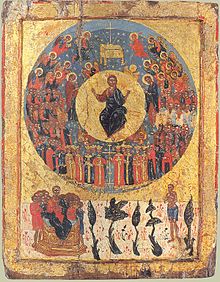
Icon of the Second Coming. Greek, ca. 1700 A.D.
Religious movements which expect that the
second coming of Christ as a cataclysmic event are generally called
adventism. These have arisen throughout the Christian era, but were particularly common after the
Protestant Reformation.
Emanuel Swedenborg
considered the second coming to be symbolic, and to have occurred in
1757. Along with others, he developed a religious systems around the
second coming of Christ, disclosed by new prophecy or special
revelation. The
Millerites are diverse religious groups which similarly rely upon a special gift of interpretation for predicting the second coming.
The difference between the 19th century Millerite and
Adventist movements and contemporary prophecy is that
William Miller
and his followers, based on Biblical interpretation, predicted the time
of the Second Coming in 1844. Contemporary writing of end time has
suggested that the timetable will be triggered by future wars and
moral catastrophe, and that this time of tribulation is close at hand.
Seventh-day Adventists believe Biblical prophecy to foretell an end
time scenario in which the United States works in conjunction with the
Catholic Church to mandate worship on a day other than the true Sabbath,
Saturday, as prescribed in the Ten Commandments (Exodus 20:8–11). This
will bring about a situation where one must choose for or against the
Bible as the will of God.
[25]
Preterism
Another view of the
end times is
preterism. It distinguishes
the time of the end from
the end of time. Preterists believe the term
Last Days (or
Time of the End) refers to, neither the last days of the Earth, nor the last days of humankind, but the end of the
Old Covenant between
God and
Israel; which, according to preterism, took place when the
Temple in
Jerusalem was destroyed in 70
CE.
Preterists believe that
prophecies — such as the
Second Coming, the desecration of the Temple, the destruction of Jerusalem, the
Antichrist, the
Great Tribulation, the advent of
The Day of the Lord, and a
Final Judgment — had been fulfilled when the Romans
sacked Jerusalem and destroyed its Temple.
Proponents of
full preterism do not believe in a coming
resurrection of the dead. They place this event (as well as the Second Coming) in the year 70. Advocates of
partial preterism do believe in a coming resurrection. Full preterists contend that partial preterists are merely
futurists, since they believe the Second Coming, the Resurrection, the
Rapture, and the Judgment are yet to come.
Many preterists believe that first-century
Christians experienced the Rapture to rejoin the
Christ.
According with Preterism's
interpretation of end times, many "time passages" in the
New Testament foretell a
Second Coming of the Christ, with Last Days to take place within the lifetimes of his disciples:
Matt. 10:23,
Matt. 16:28,
Matt. 24:34,
Matt. 26:64,
Rom. 13:11–12,
1 Cor. 7:29–31,
1 Cor. 10:11,
Phil. 4:5,
James 5:8–9,
1 Pet. 4:7,
1 Jn. 2:18.
Dispensationalist prophecies
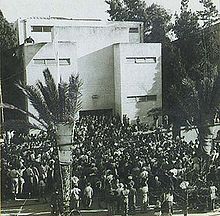
A celebratory crowd gathered in
Tel Aviv to hear the Declaration of Independence. The reestablishment of Israel provided impetus to
dispensationalism.
Dispensationalism is an
evangelica futurist Bibilical interpretation that foresees a series of
dispensations, or periods, in which God relates to human beings under different
Biblical covenants. The belief system is primarily rooted in the writings of
John Nelson Darby and
premillennial in content. The
reestablishment of Israel
in 1948 provided a major impetus to the dispensationalist belief
system. The wars of Israel after 1948 with its Arab neighbors provided
further support, according to
John F. Walvoord.
[26] After the
Six Day War in 1967, and the
Yom Kippur War in 1973, it seemed plausible to many
Fundamentalist Christians
in the 1970s that Middle East turmoil may well be leading up to the
fulfillment of various Bible prophecies and to the Battle of
Armageddon.
Members of the dispensationalist movement such as
Hal Lindsey,
J. Dwight Pentecost,
John Walvoord, all of whom have
Dallas Theological Seminary backgrounds, and some other writers, claimed further that the
European Economic Community, which preceded the
European Union, would become a
United States of Europe, which would in turn become a Revived Roman Empire ruled by the
Antichrist. The Revived Roman Empire also figured into the
New Testament
writers' vision of the future. The fact that in the early 1970s, there
were (erroneously thought to be) seven nations in the European Economic
Community was held to be significant; this aligned the Community with a
seven-headed beast mentioned in Revelation. This specific prophecy has
required revision, but the idea of a Revived Roman Empire remains.
The separate destinies of the Church and Israel, a belief which is inherent in
dispensationalism
is a particular concern to some Jews and evangelical Christians.
Evangelicals who reject dispensationalism, such as those who hold to a
Post Tribulation Rapture,
(or more accurately a Post Tribulation Resurrection-Rapture), see both
the Church and Israel entering the crucible of the End Time together.
"The Jerusalem Declaration on Christian Zionism". Riah Abu El-Assal, Swerios Malki Mourad, His Beatitude Michel Sabbah, Bishop Dr. Munib Younan.
Dispensationalism, in contrast to the Millerite Adventist movement, had its beginning in the 19th century, when
John Nelson Darby, founder of the
Plymouth Brethren religious denomination, incorporated into his system of Biblical interpretation a system of organizing Biblical time into a number of discrete
dispensations, each of which marks a separate
covenant with God. Darby's beliefs were widely publicized in
Cyrus I. Scofield's
Scofield Reference Bible, an annotated Bible that became popular in the United States of America.
Since the majority of the Biblical prophets were writing at a time when the
Temple in Jerusalem
was still functioning, they wrote as if it would still be standing
during the prophesied events. According to preterism, this was a
fulfillment of the prophecies. However, according to
Futurists,
their destruction in AD 70 put the prophetic timetable on hold. Many
such believers therefore anticipated the return of Jews to Israel and
the
reconstruction of the Temple before the Second Coming could occur.
[27][28]
Post-tribulation pre-millennialists
A view of the Second Coming of Christ as held by post-tribulational
pre-millennialists is unique, though not widely held in the Protestant
Church because of its connotations, in particular that the Church of
Christ will have to undergo great persecution.
Specific prophetic movements
In 1843,
William Miller
made the first of several predictions that the world would end in only a
few months. As his predictions did not come true (referred to as the
Great Disappointment),
followers of Miller went on to found separate groups, the most successful of which is the
Seventh-day Adventist Church.
Members of the
Bahá'í Faith believe that Miller's interpretation of signs and dates of the coming of Jesus were, for the most part, correct.
[29]
They believe that the fulfillment of biblical prophecies of the coming
of Christ came through a forerunner of their own religion, the
Báb. According to the Báb's words, 4 April 1844 was "the first day that the Spirit descended" into his heart.
[30] His subsequent declaration to
Mullá Husayn-i Bushru'i that he was the "Promised One"—an event now commemorated by Bahá'ís as a
major holy day—took place on 23 May 1844. It was in October of that year that the Báb embarked on a
pilgrimage to Mecca, where he openly declared his claims to the
Sharif of Mecca.
[31][32] The first news coverage of these events in the West was in 1845 by
The Times,
[33] followed by others in 1850 in the United States.
[34] The first Bahá'í to come to America was in 1892.
[31]
Several Bahá'í books and pamphlets make mention of the Millerites, the
prophecies used by Miller and the Great Disappointment, most notably
William Sears's
Thief in the Night.
[35][36][37]
Restorationism (Christian primitivism)
End times theology is also significant to
restorationist Christian religions, which consider themselves distinct from both Catholicism and Protestantism.
Jehovah's Witnesses

Current Watch Tower headquarters in
Brooklyn. The society made a number of emphatic claims of impending last days and ensuing chaos between 1879–1924.
The
eschatology of
Jehovah's Witnesses is central to their religious beliefs. They believe that
Jesus Christ
has been ruling in heaven as king since 1914 (a date they believe was
prophesied in Scripture), and that after that time a period of cleansing
occurred, resulting in God's selection of the
Bible Students associated with
Charles Taze Russell to be his people in 1919. They also believe the destruction of those who reject their message
[38] and thus willfully refuse to obey God
[39][40] will shortly take place at
Armageddon, ensuring that the beginning of the new earthly society will be composed of willing subjects of that kingdom.
The religion's doctrines surrounding 1914 are the legacy of a series of emphatic claims regarding the years 1799,
[41] 1874,
[41] 1878,
[42] 1914,
[43] 1918
[44] and 1925
[45] made in the
Watch Tower Society's
publications between 1879 and 1924. Claims about the significance of
those years, including the presence of Jesus Christ, the beginning of
the "
last days", the destruction of worldly governments and the earthly resurrection of Jewish patriarchs, were successively abandoned.
[46] In 1922 the society's principal journal,
The Watchtower,
described its chronology as "no stronger than its weakest link", but
also claimed the chronological relationships to be "of divine origin and
divinely corroborated...in a class by itself, absolutely and
unqualifiedly correct"
[47] and "indisputable facts",
[41] while repudiation of Russell's teachings was described as "equivalent to a repudiation of the Lord".
[48]
The Watch Tower Society has admitted its early leaders promoted "incomplete, even inaccurate concepts".
[49] The
Governing Body of Jehovah's Witnesses says that, unlike
Old Testament prophets, its interpretations of the Bible are not
inspired or
infallible.
[50][51][52] Witness publications
say that Bible prophecies can be fully understood only after their
fulfillment, citing examples of biblical figures who did not understand
the meaning of prophecies they received. Watch Tower publications often
cite Proverbs 4:18, "The path of the righteous ones is like the bright
light that is getting lighter and lighter until the day is firmly
established" (
NWT)
to support their view that there would be an increase in knowledge
during "the time of the end", as mentioned in Daniel 12:4. Jehovah's
Witnesses state that this increase in knowledge needs adjustments. Watch
Tower publications also say that unfulfilled expectations are partly
due to eagerness for
God's Kingdom and that they do not call
their core beliefs into question.
[53][54][55]
The Church of Jesus Christ of Latter-day Saints
Members of
The Church of Jesus Christ of Latter-day Saints
believe that there will be a Second Coming of Jesus to the earth
sometime in the future. The LDS Church and its leaders do not make any
predictions of the actual date of the Second Coming.
According to church teaching, the true
gospel will be taught in all parts of the world prior to the Second Coming.
[56]
They also believe that there will be increasing war, earthquakes,
hurricanes, and man-made disasters prior to the Second Coming.
[57]
Islam
Muslims believe that there are three periods before the Day of Judgment, also known as
ashratu's-sa'ah or
alamatu qiyami's-sa'ah, with some debate as to whether the periods could overlap.
[58][59][60]
The first period is said to have begun with the death of Muhammad.
The second began with the passing of all his Companions, and ended a
thousand years later. Another event of the second period was the Tartar
invasion, occurring 650 years after Muhammad. The Mongols, led by
Hulagu Khan, grandson of
Genghis Khan,
attacked Baghdad in 1258 AD and brought the Abbasid caliphate to an
end. They massacred millions of Muslims, and the water of the river
Tigris turned red with blood. The Qur'an also predicted a fire at
Madinah in the Hijaz near
Busra in Syria, which Islamic scholars believe occurred in 654 AH.
[58] Following the second, the third and final period will be heralded by the appearance of the
Mahdi.
[58]
Sunni
Sunnis believe that the dead will then stand in a grand assembly,
awaiting a scroll detailing their righteous deeds, sinful acts and
ultimate judgment.
[61][62] Muhammad will be the first to be resurrected.
[63] Punishments will include
adhab, or severe pain and embarrassment, and
khizy or shame.
[64] There will also be a punishment of the grave between death and the resurrection.
[65]
Major signs
There are twelve major signs of
Qiyamah, known as
amaratu's-sa'ah al- kubra. The first sign will be the appearance of the imam, Mahdi, whose appearance is awaited by the angel
Israfil,
so that he may sound the horn signalling the end of days. The natural
order will become reversed, including the sun, mountains and sea.
[66]
The twelve signs are as follows:
- Rise (or Occultation in Shia belief) of the Mahdi.[59][66]
- The false messiah, Masih ad-Dajjal, shall appear as a creature with one eye good and the other blind, and the mark of Kafir. He will claim to hold keys to heaven and hell and lead many astray, although believers will not be deceived.[60][67]
- Medina will be deserted, with true believers going to follow Mahdi and sinners following Dajjal
- Isa, or Jesus, shall return from the seventh sky to assist the Mahdi against Dajjal[68]
- Ya'jooj and Ma'jooj,
two tribes of vicious beings which had been imprisoned will escape.
They will ravage the earth, drink all its water, and destroy all life.
Allah will then send worms and insects to destroy them.[60][69][70]
- The sun will rise from the west.[71][72][73] At this point, it is useless for humans want to atone their sins
- The Beast of the Earth, or Dabbat al-ard, will populate the entire planet[74] The Beast will mark every people on earth based on their beliefs (believers or unbelievers)
- The Qur'an will be taken to heaven and even the Hafiz will not recall its verses
- A pleasant breeze will blow from Yemen that will cause all believers
to die peacefully, leaving the Earth with the wicked unbelievers
- A short legged and thin ruler of Ethiopia will attack Mecca and destroy the Kaaba, and throw its stones to the sea
- A first trumpet will sound, and all remaining humanity will die,
followed by a period of forty years, at the end of which smoke will
envelop the world for forty days
- A second trumpet will sound, the dead will return to life, and a
fire will start from Hadramawt in Yemen that shall gather all people of
the world in Mahshar for the Last Judgment
Shia
Concepts and terminology in Shia eschatology includes
Mi'ad,
The Occultation and
Al-Yamani,
Sufyani In Twelver Shia hadiths about the last days, the literature largely revolves around
Muhammad al-Mahdi,
a messianic figure considered to be the twelfth appointed successor to
Muhammad. Mahdi will help mankind against the deception by a man called
Dajjal who will try to woe (woo?) people to a new world religion which is called "the great deception".
[75]
Ahmadiyya
Ahmadiyya
is considered distinct from mainstream Islam. In its writing, the
present age has been witness to the evil of man and wrath of God, with
war and natural disaster.
[76] Ghulam Ahmad is seen as the
promised Messiah and the
Mahdi,
fulfilling Islamic and Biblical prophecies, as well as scriptures of
other religions such as Hinduism. His teaching will establish spiritual
reform and establish an age of peace. This will continue for a thousand
years, and will unify mankind under one faith.
[77]
Ahmadis believe that despite harsh and strong opposition and
discrimination they will eventually be triumphant and their message
vindicated both by Muslims and non-Muslims alike. Ahmadis also
incorporate the eschatological views from other religions into their
doctrine and believe that Mirza Ghulam Ahmed falls into this sequence.
[78]
Bahá'í Faith
The founder of the
Bahá'í Faith,
Bahá'u'lláh claimed that he was the
return of Christ as well as prophetic expectations of other religions.
[79] The inception of the Bahá'í Faith coincides with
Millerite prophesy, pointing to the year 1844. They also believe the
Battle of Armageddon has passed and that the mass martyrdom anticipated during the
End Times had already passed within the
historical context of the Bahá'í Faith.
[80][81] Bahá'ís expect their faith to be eventually embraced by the masses of the world, ushering in a
golden age.
Rastafari movement
Rastafarians have a unique interpretation of end times, based on the
Old Testament and the
Book of Revelation. They believe
Ethiopian Emperor
Haile Selassie I to be God
incarnate, the
King of kings and
Lord of lords mentioned in Revelation 5:5. They saw the crowning of Selassie as the
second coming, and the
Second Italo-Ethiopian War
as fulfillment of Revelation. There is also the expectation that
Selassie will return for a day of judgment and bring home the lost
children of Israel, which in Rastafarianism refer to those taken from
Africa through the
slave trade. There will then be an era of peace and harmony at Mount
Zion in Africa.
[82]
Cyclic cosmology
Norse religion
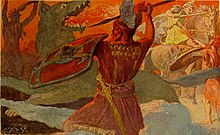
Odin fighting his old nemesis
Fenrir
Norse mythology depicts the end of days as
Ragnarök, an
Old Norse term translatable as "twilight of the gods". It will be heralded by a devastation known as
Fimbulwinter which will seize
Midgard
in cold and darkness. The sun and moon will disappear from the sky, and
poison will fill the air. Dead will rise from the ground and there will
be widespread despair.
There follows a battle between - on the one hand - the Gods with the
Æsir,
Vanir[citation needed] and
Einherjar, led by
Odin, and - on the other hand - forces of Chaos, including the fire giants and
jötunn, led by
Loki. In the fighting
Odin will be swallowed whole by his old nemesis
Fenrir.
[83] The god
Freyr fights
Surtr but loses.
Víðarr,
son of Odin, will then avenge his father by ripping Fenrir's jaws apart
and stabbing the wolf in the heart with his spear. The serpent
Jörmungandr will open its gaping maw and be met in combat by
Thor. Thor, also a son of Odin, will defeat the serpent, only to take nine steps afterwards before collapsing to his own death.
[84]
After this people will flee their homes as the sun blackens and the
earth sinks into the sea. The stars will vanish, steam will rise, and
flames will touch the heavens. This conflict will result in the deaths
of most of the major Gods and forces of Chaos. Finally,
Surtr will fling fire across the nine worlds. The ocean will then completely submerge
Midgard.
[85]
After the cataclysm the world will resurface new and fertile, and the surviving Gods will meet. The two human survivors,
Líf and Lífþrasir, will then repopulate this new earth.
[86]

Ragnarök after Surtr has engulfed the world with fire
Hinduism
In
Hindu eschatology, time is cyclic and consists of
kalpas. Each lasts 4.1 – 8.2 billion years, which is a period of one full day and night for
Brahma, who will be alive for 311 trillion, 40 billion years. Within a
kalpa there are periods of
creation,
preservation and
decline. After this larger cycle, all of creation will contract to a
singularity and then again will expand from that single point, as the
ages continue in a religious
fractal pattern.
[60]
Within the current kalpa, there are four epochs that encompass the
cycle. They progress from a beginning of complete purity to a descent
into total corruption. The last of the four ages is
Kali Yuga,
our current time, during which will be characterized by impiety,
violence and decay. The four pillars of dharma will be reduced to one,
with truth being all that remains.
[87] As written in the
Gita:
Yadā yadā hi dharmasya glānirbhavati Bhārata
Abhyutthānam adharmasya tadātmānam sṛjāmyaham
Whenever there is decay of righteousness O! Bharata
And a rise of unrighteousness then I manifest Myself![88]
At this time of chaos, the final avatar,
Kalki,
endowed with eight superhuman faculties will appear on a white horse.
Kalki will amass an army to "establish righteousness upon the earth" and
leave "the minds of the people as pure as crystal."
At the completion of
Kali Yuga, the next cycle will begin with a new
Satya Yuga,
in which all will once again be righteous with the reestablishment of
dharma. This, in turn, will be followed by epochs of Treta Yuga, Dwapara
Yuga and again another Kali Yuga. This cycle will then repeat till the
larger cycle of existence under
Brahma returns to the
singularity, and a new universe is born.
[82]
Buddhism
There are two major points of Buddhist eschatology, the appearance of
Maitreya, followed by the Sermon of the Seven Suns.
Maitreya
Buddha described his teachings disappearing five thousand years from
when he preached them, corresponding approximately to the year 2300. At
this time, knowledge of
dharma will be lost as well. The last of his relics will be gathered in Bodh Gaya and cremated.
[citation needed]
There will be a new era in which the next Buddha Maitreya will appear,
but it will be preceded by the degeneration of human society. This will
be a period of greed, lust, poverty, ill will, violence, murder,
impiety, physical weakness, sexual depravity and societal collapse, and
even the Buddha himself will be forgotten.
[60]
This will be followed by the coming of Maitreya when the teachings of
dharma are forgotten. Maitreya was the first bhoddisatva around whom a cult developed, in approximately the 3rd century CE.
[89]
The earliest mention of Maitreya is in the Cakavatti, or Sihanada Sutta in
Digha Nikaya 26 of the
Pali Canon. In it,
Gautama Buddha predicted that his teachings of dharma would be forgotten after 5,000 years.
“At that period, brethren, there will arise in the world an Exalted
One named Maitreya, Fully Awakened, abounding in wisdom and goodness,
happy, with knowledge of the worlds, unsurpassed as a guide to mortals
willing to be led, a teacher for gods and men, an Exalted One, a Buddha,
even as I am now. He, by himself, will thoroughly know and see, as it
were face to face, this universe, with Its worlds of the spirits, Its
Brahmas and Its Maras, and Its world of recluses and Brahmins, of
princes and peoples, even as I now, by myself, thoroughly know and see
them”
— Digha Nikaya, 26
Maitreya Buddha is then foretold to be born in the city of Ketumatī
in present-day Benares, whose king will be the Cakkavattī Sankha. Sankha
will live in the former palace of King Mahāpanadā, and will become a
renunciate who follows Maitreya.
[90][91]
In Mahayana Buddhism, Maitreya will attain
bodhi
in seven days, the minimum period, by virtue of his many lifetimes of
preparation. Once Buddha, he will rule over the Ketumati Pure Land, an
earthly paradise sometimes associated with the Indian city of
Varanasi or Benares in Uttar Pradesh. In Mahayana Buddhism, the Buddha presides over a land of purity. For example,
Amitabha presides over Sukhavati, more popularly known as the 'Western Paradise'.
[92]
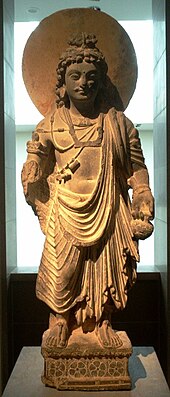
Bodhisattva Maitreya from the 2nd Century Gandharan Art Period
A notable teaching he will rediscover is that of the ten non-virtuous
deeds—killing, stealing, sexual misconduct, lying, divisive speech,
abusive speech, idle speech, covetousness, harmful intent and wrong
views. These will be replaced by the ten virtuous deeds, which are the
abandonment of each of these practices. He is described by Conze in his
Buddhist Scriptures:
The Lord replied, 'Maitreya, the best of men, will then leave the Tuṣita
heavens, and go for his last rebirth. As soon as he is born he will
walk seven steps forward, and where he puts down his feet a jewel or a
lotus will spring up. He will raise his eyes to the ten directions, and
will speak these words: "This is my last birth. There will be no rebirth
after this one. Never will I come back here, but, all pure, I shall win
Nirvana."
— Buddhist Scriptures [93]
He currently resides in
Tushita, but will come to
Jambudvipa when needed most as successor to the historic
Śākyamuni Buddha.
Maitreya will achieve complete enlightenment during his lifetime, and
following this reawakening, he will bring back the timeless teaching of
dharma to this plane and rediscover
enlightenment.
[94] The
Arya Maitreya Mandala, founded by
Lama Anagarika Govinda is based on the idea of Maitreya.
Maitreya eschatology forms the central canon of the
White Lotus Society, a revolutionary movement during
British colonial rule. It later branched into the
Chinese underground criminal organization known as the
Triad, which exists today as an international underground criminal network.
It is of note that description of Maitreya occurs in no other sutta
in the canon, casting doubt as to authenticity of the scripture. In
addition, sermons of the Buddha normally are in response to a question,
or in a specific context, but this sutta has a beginning and an ending,
and its content is quite different from the others. This has led some to
conclude that the whole sutta is apocryphal, or tampered with.
[94]
Sermon of the Seven Suns
In his "Sermon of the Seven Suns" in the
Pali Canon,
the Buddha describes the ultimate fate of the world in an apocalypse
that will be characterized by the consequent appearance of seven suns in
the sky, each causing progressive ruin till the Earth is destroyed:
All things are impermanent, all aspects of existence are unstable and
non-eternal. Beings will become so weary and disgusted with the
constituent things that they will seek emancipation from them more
quickly. There will come a season, O monks when, after hundreds of
thousands of years, rains will cease. All seedlings, all vegetation, all
plants, grasses and trees will dry up and cease to be...There comes
another season after a great lapse of time when a second sun will
appear. Now all brooks and ponds will dry up, vanish, cease to be.
— Aňguttara-Nikăya, VII, 6.2 Pali Canon[60]
The canon goes on to describe the progressive destruction of each sun. A third sun will dry the mighty
Ganges and other great rivers. A fourth will cause the great lakes to evaporate, and a fifth will dry the oceans. Finally:
Again after a vast period of time a sixth sun will appear, and it
will bake the Earth even as a pot is baked by a potter. All the
mountains will reek and send up clouds of smoke. After another great
interval a seventh sun will appear and the Earth will blaze with fire
until it becomes one mass of flame. The mountains will be consumed, a
spark will be carried on the wind and go to the worlds of God....Thus,
monks, all things will burn, perish and exist no more except those who
have seen the path.
— Aňguttara-Nikăya, VII, 6.2 Pali Canon[60]
The sermon completes with the planet engulfed by a vast inferno. The
Pali Canon does not indicate when this will happen relative to Maitreya.
[6


